
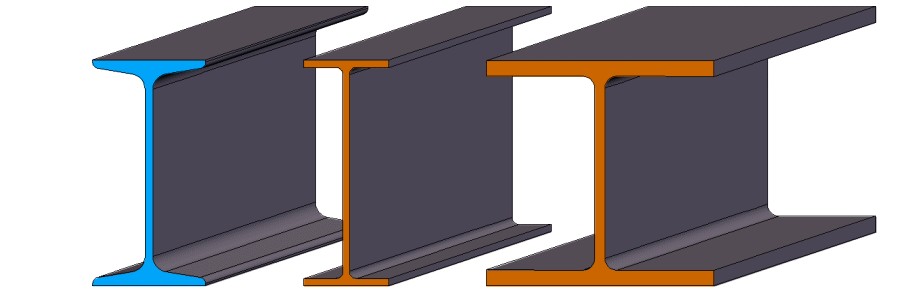
Steel beams—such as H-beams, W-beams, and S-beams—are used to support heavy loads. In fact, they are the most common component in structural framing systems. Steel beams are used to construct bridges, warehouses, and other large buildings, and even for the frames of machinery or truck bodies. Steel beams can be placed on their sides or at an angle and are connected to columns by bolts, welding, and beam supports.
To understand the differences between H-beams, W-beams, and S-beams, you must first understand the meaning of these letters and the naming rules for steel beams.
How are steel beams named?
One of the most common questions about steel beams is how their shapes are named. What information do these names tell us about the structure's shape? Generally, the names of steel beams and other structural steel materials are directly related to the product's shape, cross-section, or weight.
In addition to the T-beams, each steel beam has a vertical section called the web, and horizontal sections located at the top and bottom of the web, called legs or flanges. Depending on the direction of rotation of the beam, this forms the shape of a capital letter I or a capital letter H.
In S-beams, "S" stands for "standard," and in W-beams, "W" stands for "wide flange." An I-beam is a standard beam, while an H-beam is a wide flange beam.
The unique geometry and high strength of beams enable them to resist shear stress and bending, thus they are widely used in general construction and civil engineering. However, the specific application depends on the beam's geometry. For example, beams can serve as key support columns in large building structures. These support columns are called H-piles, load-bearing piles, or HP beams. They are typically heavier and thicker than S-beams or W-beams.
What are the components of a steel beam?
The vertical web and the horizontal flanges/spars constitute the basic components of a steel beam.
Tapered and Non-Tapered Flanges
Like other structural steels, steel beam flanges can be tapered. A tapered flange creates a slope at the four inner corners where the flange connects to the web, making these areas
thicker than the rest of the beam. This slope extends along the flange, forming rounded corners.
Flanges can also be parallel or non-tapered, resulting in more square edges due to the uniform thickness throughout the beam. Tapered flanges, with their greater thickness at
critical structural points, offer better resistance to bending. However, their rounded corners make connections to other structures more difficult, so engineers may opt for I-beams.
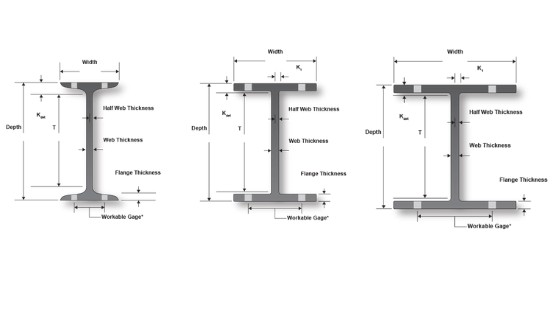
S-shaped beams, W-shaped beams, and H-shaped beams
S-beams
S-beams (sometimes called American Standard steel) are characterized by their tapered legs. While W-beams and H-beams have legs that meet the web at a uniform right angle,
S-beams have rounded legs that remain rounded throughout. The slope of their inner flanges is 2:12 (approximately 16.67%), another key feature of S-beams.
The width of the legs is another crucial characteristic of S-beams, being narrower than both W-beams and H-beams. Furthermore, S-beams have a very narrow dimensional range.
S-beams are most commonly used in the construction and shipbuilding industries.
W-beams
The "W" in W-beam stands for "wide flange." The main characteristic of W-beams is that their inner and outer flange surfaces are parallel. Furthermore, the overall depth of a W-beam
must be at least equal to the flange width. Typically, its depth is much greater than its width.
One advantage of W-beams is that their flanges are thicker than their webs. This helps resist bending stresses.
Compared to H-beams or S-beams, W-beams have a wider range of standard cross-sectional dimensions. Due to their broader size range (from a minimum of W4x14 to a maximum
of W44x355), they are considered one of the most commonly used beams in construction worldwide today.
H-beams
H-beams are currently the largest and heaviest steel beams, capable of withstanding greater loads. They are sometimes called HP beams, H-piles, or load-bearing piles, stemming
from their common use in the underground foundation supports (load-bearing columns) of skyscrapers and other large buildings.
Similar to W-beams, the inner and outer flanges of H-beams are parallel. However, the flange width of an H-beam is approximately equal to the depth of the beam, and the beam
thickness is also uniform.
Steel beams are the foundation support structures for many building and engineering projects. They are just one shape of structural steel, but due to the wide variety of steel beam
types, it is important to be able to distinguish them.
What do H-beams, W-beams, and S-beams have in common?
H-beams, W-beams, and S-beams are all types of beams. The selection of a beam is typically based on its ability to bend rather than buckle under high stress. Most beams are made
of structural steel or high-strength low-alloy steel and are fabricated by structural steel manufacturers. You will find various types of beams widely used in a variety of fields, including
building frames, bridges, and general structural applications; the type of beam depends on the specific application.